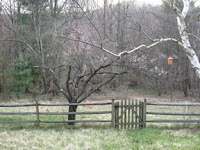
April 1 is the eighth anniversary of my relationship with a plum tree. My family moved into our house on Tinted Hill that day in 2000 and ate our first chilly dinner on the deck, overlooking our new yard. Through the branches of a white birch (my very favorite yard tree since we don’t have a pine), we relished a profusion of blooms on the little plum. I can’t remember what we were eating, but I recall that pink and white, bright against the leafless gray woods behind us.

My then-teenaged son, who was practicing calligraphy that year, might have known a poem about plum trees by Lin Bu (967-1028):
their scattered shadows fall lightly on clear water
their subtle scent pervades the moonlit dusk
snowbirds look again before they land
butterflies would faint if they but knew. . . .
Such trees, Lin Bu thought, shame the rest of the garden by flowering so boldly in early spring. I imagined my young children playing, spring after spring, on our greening grass in the plum-sweetened air. I knew all four kids would grow taller, and I assumed the tree would too, shading their summers for a long, unforeseeable future.
Fast forward to 2008. “Oh-8, Oh-8, Oh-8!” shout my daughter & friends at every high school game, delirious that their childhood days will end officially at graduation, May 29. Even Hannah’s little brother, not yet walking when we moved here, could now scale the plum if I let him. But I cannot. The tree is too fragile this spring, with a pale smattering of blooms, asymmetrically distributed. Last year, it seemed merely fading. This year, it looks half dead. My neighbor, in a fluster, told me last week—“I saw white blobs on some of my trees. It’s spreading!” White blobs? I asked. “From your plum!” Apparently, Rita thinks it has a contagious disease. And she wants it cut down.
Live without my plum tree? The idea shocks me. Can’t Rita see its graceful, twisted limbs from her windows? Hasn’t she heard of the food and shelter value of snags to birds and other wildlife? But living here a decade before we arrived, perhaps she’s watched the plum descend from a glory I never witnessed. Though her daughters never hosted a doll tea party beside it, her loss in some ways may be greater than mine.

The latter possibility occurred to me as I read Jonathan Rosen’s eloquently questioning Life of the Skies, especially a chapter on Robert Frost’s poem, “The Ovenbird”. Rosen calls that work, “a lament for a world that has lost its wildness,” meaning vanished creatures and degraded spaces but also a human spirit desiccating in a less-wild world. Two lines from the poem haunted Rosen as he sought ivory-billed woodpeckers in a cut-over Arkansas swamp and resonate with me as I see my plum through Rita’s eyes:
The question that he frames in all but words
Is what to make of a diminished thing.
To my knowledge, no ovenbird has sung on my plum’s branches. But uncounted wrens have fledged from a house that dangles from one limb. These days, the tree is ever-more popular with chickadees, undaunted by the gray-green lichens Rita fears. They peck and pry at its peeling bark after fat grubs for their nestlings. My eight-year-old pokes and prods it too, more gently than the birds I expect, investigating each ridge and fissure with eyes keener than mine. One yard over, Rita lives too far away, and, shopping for prom, his sister is too busy. But Eli, hands-on, knows that dying tree might host “a roosting bat, maybe” or “a snake!”
Eli’s book-bound mom thinks of another Robert Frost poem to answer the ovenbird, for Frost also wrote about chickadees’ defiant vitality in the face of a merciless storm:
. . . . and yet to-morrow
They will come budding boughs from tree to tree
Flirting their wings and saying Chickadee,
As if not knowing what you meant by the word storm.
Maybe ovenbirds and chickadees see the world differently, like Rita and me. Annie Dillard says the “secret of seeing” is to spread your spirit like a sail, until it is “whetted, transclucent” . My unfledged children, at least, retain that sailing spirit, and as long as my plum has wildness enough for Eli, it stays.

For Eli knows a more succinct answer than books can give to Frost and Rosen’s question—how do you love a diminished world? Eli says, “Look closer.”
_____________________________
All 700 + of the above words are just my way of introducing an insightful, unqualified rave review of Life of the Skies by Mike over at 10,000 Birds. Life, says Mike, “astonishes instantly with a scope that draws together disparate threads from the arts and sciences to weave a sophisticated understanding of birdwatching’s allure.” Even better news: he’s giving some away to a lucky few. Visit 10,000 Birds to learn how to win your own copy of a book Mike aptly calls, “truly remarkable.”


